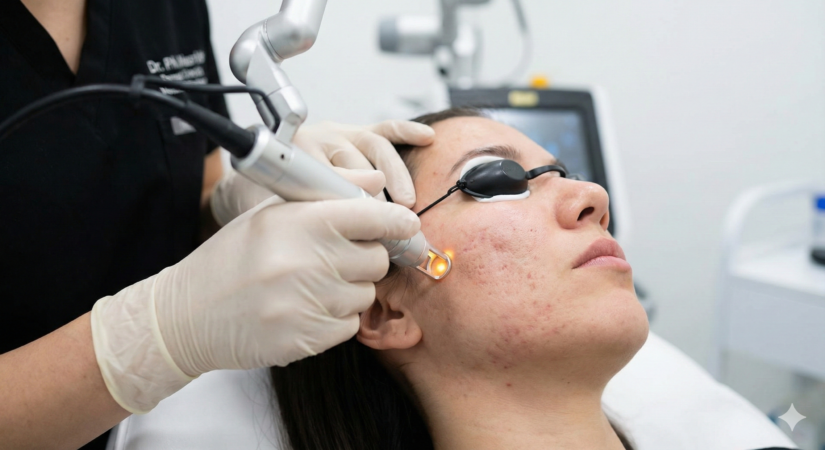
Dealing with acne is tough. Dealing with the scars it leaves behind can feel even more frustrating, especially when creams and serums have not made a difference.
The good news is that you do not have to live with uneven skin texture indefinitely. At First Ave Medical Spa in Kitsilano, we provide professional acne scar treatment matched to the specific type of scarring you have.
That last part matters more than most people realise.
When a breakout becomes inflamed, your body repairs the wound by producing collagen. Scarring occurs when that repair process goes slightly wrong in either direction.
Too little collagen leaves a depression in the skin. Too much creates a raised scar. According to the Canadian Dermatology Association, this damage sits deep in the skin layers, which is why surface-level home remedies rarely change the texture of an established scar.
This is the step most people skip, and it is the reason some treatments disappoint. Different scar types respond to entirely different approaches.
Post-inflammatory hyperpigmentation (PIH) is flat discolouration left after a breakout heals. It is not technically a scar at all, and it often fades on its own over months. It responds to resurfacing and pigment-targeting treatments.
Rolling scars are broad, shallow depressions with sloping edges, giving skin a slightly wavy appearance. They respond well to collagen-stimulating treatments.
Boxcar scars are wider depressions with sharper, more defined edges. They typically need resurfacing or collagen stimulation, sometimes combined.
Icepick scars are narrow, deep, and steep-sided. These are the most stubborn type and often respond least to standard resurfacing, sometimes needing a more targeted approach.
Raised or hypertrophic scars sit above the skin surface. These need a different strategy entirely from depressed scarring.
Most people have a combination. Identifying which types you have is the entire point of a proper consultation, and it is why a treatment that worked beautifully for a friend may do very little for you.
At our Vancouver clinic, treatment is matched to scar type rather than offered from a fixed menu.
Fine needles create controlled micro-channels, prompting your body to produce fresh collagen that fills depressed areas over time.
Combines microneedling with radiofrequency energy to reach deeper layers, supporting collagen remodelling below the surface.
Medical grade solutions remove damaged surface layers, improving tone and shallow texture.
For individual deep depressions, filler can lift the scar so it sits level with surrounding skin.
At-home rollers and topical products can support skin health, but they cannot reach the dermis where scar tissue actually sits.
Professional acne scar treatment differs because:
The Canadian Skin Patient Alliance notes that over-the-counter products can help with discolouration but rarely change underlying scar texture.
Skin healing takes time. After your acne scar treatment, collagen rebuilding happens gradually over weeks and months rather than overnight.
Most clients see meaningful improvement across a series of sessions. Your consultation will outline a realistic plan and timeline for your specific scarring.
Daily sunscreen is essential throughout, since healing skin is more vulnerable to pigmentation changes. Vancouver Coastal Health notes UV exposure remains significant even on overcast days, which matters year-round in Vancouver.
First Ave Medical Spa has served Kitsilano and the wider Vancouver area since 2008. Our physician directed team follows standards set by the BC College of Physicians and Surgeons.
As a boutique clinic, we have the time to properly assess your scarring before recommending anything. For clients whose scarring would be better served by a different approach than we offer, we will say so.
Clear, smoother skin is achievable with a plan matched to your actual scar type.
Our team will assess your scarring and design an acne scar treatment plan built around what you specifically have, not a standard package.
Book your consultation today at First Ave Medical Spa in Kitsilano.
Which acne scar treatment works best? It depends on your scar type. Rolling and boxcar scars generally respond to collagen-stimulating treatments, while post-inflammatory hyperpigmentation responds to resurfacing. Icepick scars are the most stubborn and may need a targeted approach.
How long does acne scar treatment take to work? Collagen rebuilding happens gradually over weeks and months. Most clients see meaningful improvement across a series of sessions rather than after a single treatment.
Can acne scars be removed completely? Most treatments significantly improve the appearance of scarring rather than removing it entirely. Realistic improvement varies by scar type and depth.
Should I treat acne scars while still breaking out? Active acne generally needs to be under control before scar treatment begins. Your consultation will assess whether the timing is right.